> ## Documentation Index
> Fetch the complete documentation index at: https://docs.videngineer.com/llms.txt
> Use this file to discover all available pages before exploring further.
# Cast & World
> Every recurring character, location, and prop — as reusable reference sheets, with one-click transparent-PNG cutouts.
Cast & World answers: **who and what is on screen?** The engine identifies every recurring character, environment, and key object across the video and writes each one up as a reference sheet — with descriptions specific enough to hand to an image model, and a `best_frame` chosen to show that entity clearly and alone.
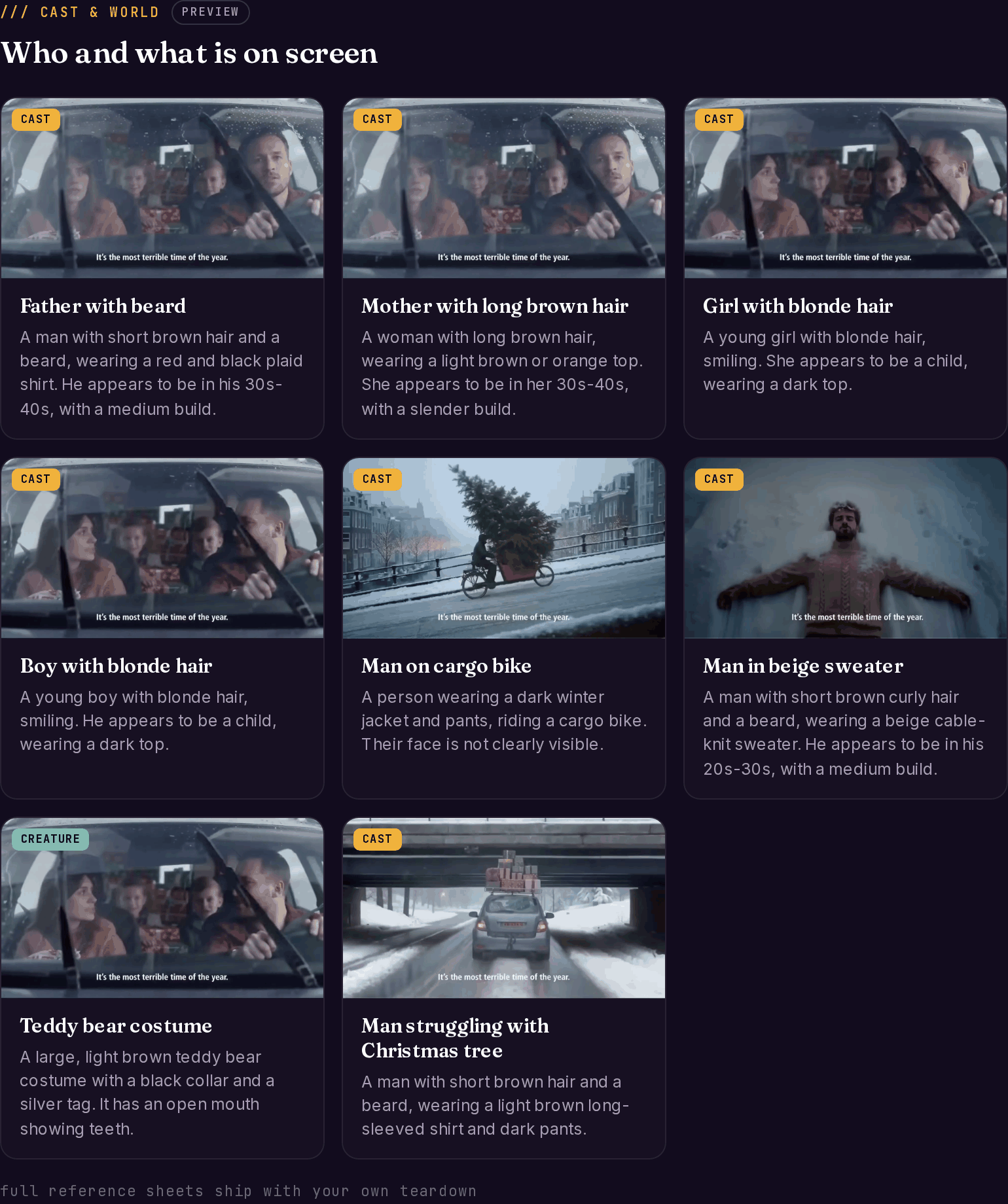 *Live example: [McDonald's — AI-generated Christmas ad teardown](https://videngineer.com/teardowns/ads/mcdonalds-ai-generated-christmas-ad-teardown/), Cast & World tab.*
## How entities are clustered
The same character across different expressions, poses, and angles is merged into **one** entry — identity is judged by body shape, clothing, hair, and design, not by expression. So "girl looking scared" and "girl smiling" become one character with all her frame appearances combined. Each entity's `best_frame` prefers a clean solo shot (close-up or medium), never a group wide.
## Field reference
### `characters`
| Field | What it holds |
| --------------------------------------- | ------------------------------------------------------------------------------------------------------------------------ |
| `name` | Core identity, descriptive — "Little girl in polka dot dress", "Father with beard" |
| `type` | `human` \| `animated` \| `voiceover` |
| `description` | A detailed visual description written for AI image generation — clothing, hair, build, accessories, distinguishing marks |
| `role` | `main` \| `supporting` \| `background` |
| `screen_time_pct` | Share of the video this character is on screen |
| `appearances` / `frames` / `best_frame` | Every frame they appear in, plus the cleanest reference frame |
### `environments`
| Field | What it holds |
| --------------------------------------- | ------------------------------------------------------------------- |
| `name` | Location name — "Tuscan vineyard aerial", "Dark warehouse interior" |
| `type` | `indoor` \| `outdoor` \| `digital` \| `abstract` |
| `description` | Recreation-ready: lighting, time of day, weather |
| `mood` | e.g. `epic` \| `warm` \| `dramatic` \| `clean` \| `corporate` |
| `appearances` / `frames` / `best_frame` | Where it appears, plus the most representative shot |
### `objects`
| Field | What it holds |
| ---------------------------- | ------------------------------------------------------------------- |
| `name` / `category` | `product` \| `vehicle` \| `prop` \| `text` \| `graphic` \| `animal` |
| `significance` | `high` \| `medium` \| `low` |
| `description` | Brief visual description, brand noted when visible |
| `appearances` / `best_frame` | Frequency and the best reference shot |
### Video-level fields
* `visual_style` — one sentence on the overall look: lighting, color grade, camera work
* `color_palette` — five hex codes
* `production_notes` — what you'd need to recreate this world: required assets, lighting setup, camera angles
## One-click isolation — transparent PNG cutouts
Any character, prop, or location reference frame can be isolated with one click: the background is removed and you get a **transparent PNG cutout**, stored with the teardown and ready for mood boards, style frames, or compositing tests. Each cutout costs **1 credit**, charged only after the file is successfully stored — and reopening a cutout you've already made never charges again.
## What to do with it
* **Cast from the description, not the footage.** The character descriptions are written as casting/generation specs — same archetype, your own person or generated character.
* **Count the world.** Three environments and five props is a very different production than one desk and a laptop. The entity list is your scope estimate.
* **Use `screen_time_pct` to find the real protagonist.** In ads, the entity with the most screen time is often the *emotion carrier*, not the product — that's a structural choice worth noticing.
* **Pull cutouts into your style frames** to test compositions before you shoot or generate anything.
## Related layers
The shots these entities appear in, as playable clips.
Prompts that reuse these descriptions to build your version.
The visual stats around this cast — shot mix, palette, pacing.
What all these people and props are actually doing for the message.
*Live example: [McDonald's — AI-generated Christmas ad teardown](https://videngineer.com/teardowns/ads/mcdonalds-ai-generated-christmas-ad-teardown/), Cast & World tab.*
## How entities are clustered
The same character across different expressions, poses, and angles is merged into **one** entry — identity is judged by body shape, clothing, hair, and design, not by expression. So "girl looking scared" and "girl smiling" become one character with all her frame appearances combined. Each entity's `best_frame` prefers a clean solo shot (close-up or medium), never a group wide.
## Field reference
### `characters`
| Field | What it holds |
| --------------------------------------- | ------------------------------------------------------------------------------------------------------------------------ |
| `name` | Core identity, descriptive — "Little girl in polka dot dress", "Father with beard" |
| `type` | `human` \| `animated` \| `voiceover` |
| `description` | A detailed visual description written for AI image generation — clothing, hair, build, accessories, distinguishing marks |
| `role` | `main` \| `supporting` \| `background` |
| `screen_time_pct` | Share of the video this character is on screen |
| `appearances` / `frames` / `best_frame` | Every frame they appear in, plus the cleanest reference frame |
### `environments`
| Field | What it holds |
| --------------------------------------- | ------------------------------------------------------------------- |
| `name` | Location name — "Tuscan vineyard aerial", "Dark warehouse interior" |
| `type` | `indoor` \| `outdoor` \| `digital` \| `abstract` |
| `description` | Recreation-ready: lighting, time of day, weather |
| `mood` | e.g. `epic` \| `warm` \| `dramatic` \| `clean` \| `corporate` |
| `appearances` / `frames` / `best_frame` | Where it appears, plus the most representative shot |
### `objects`
| Field | What it holds |
| ---------------------------- | ------------------------------------------------------------------- |
| `name` / `category` | `product` \| `vehicle` \| `prop` \| `text` \| `graphic` \| `animal` |
| `significance` | `high` \| `medium` \| `low` |
| `description` | Brief visual description, brand noted when visible |
| `appearances` / `best_frame` | Frequency and the best reference shot |
### Video-level fields
* `visual_style` — one sentence on the overall look: lighting, color grade, camera work
* `color_palette` — five hex codes
* `production_notes` — what you'd need to recreate this world: required assets, lighting setup, camera angles
## One-click isolation — transparent PNG cutouts
Any character, prop, or location reference frame can be isolated with one click: the background is removed and you get a **transparent PNG cutout**, stored with the teardown and ready for mood boards, style frames, or compositing tests. Each cutout costs **1 credit**, charged only after the file is successfully stored — and reopening a cutout you've already made never charges again.
## What to do with it
* **Cast from the description, not the footage.** The character descriptions are written as casting/generation specs — same archetype, your own person or generated character.
* **Count the world.** Three environments and five props is a very different production than one desk and a laptop. The entity list is your scope estimate.
* **Use `screen_time_pct` to find the real protagonist.** In ads, the entity with the most screen time is often the *emotion carrier*, not the product — that's a structural choice worth noticing.
* **Pull cutouts into your style frames** to test compositions before you shoot or generate anything.
## Related layers
The shots these entities appear in, as playable clips.
Prompts that reuse these descriptions to build your version.
The visual stats around this cast — shot mix, palette, pacing.
What all these people and props are actually doing for the message.