> ## Documentation Index
> Fetch the complete documentation index at: https://docs.videngineer.com/llms.txt
> Use this file to discover all available pages before exploring further.
# Hooks & re-hooks
> The opening hook — quoted, typed, and scored — plus every point where the video re-earns attention.
This layer answers: **how does the video earn attention, and how does it keep re-earning it?** The hook is quoted verbatim, classified by type, and scored; the re-hooks map every moment where the video reopens a loop, raises the stakes, or interrupts a pattern to stop you leaving.
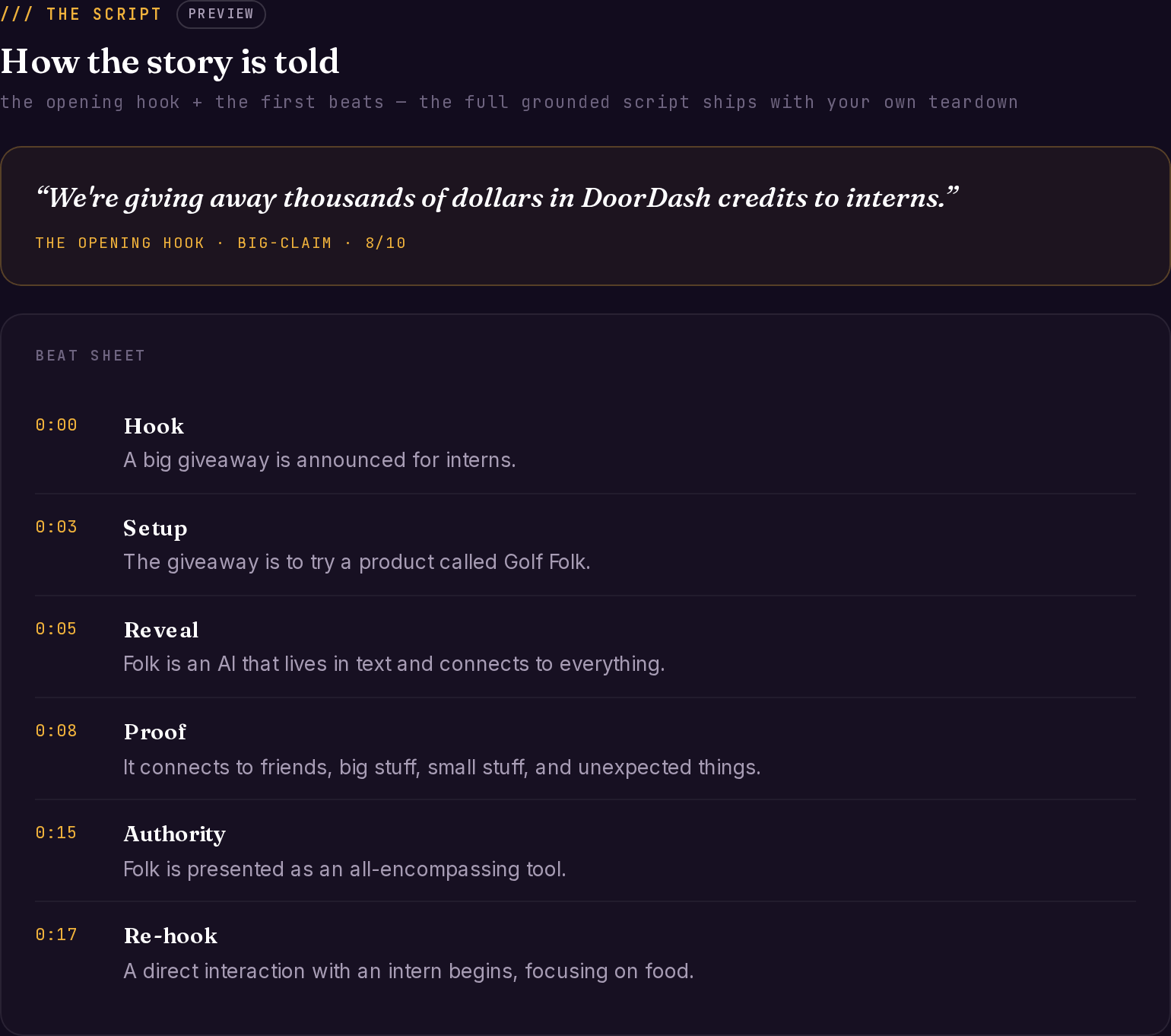 *Live example: [Folk × DoorDash — intern stunt ad teardown](https://videngineer.com/teardowns/ugc/folk-doordash-intern-stunt-ad-teardown/), The Script tab.*
## The hook
| Field | What it holds |
| ----------------------- | ------------------------------------------------------- |
| `text` | The verbatim opening line, max 25 words |
| `start_sec` / `end_sec` | Where the hook runs — typically the first 10–30 seconds |
| `type` | What kind of open it is (below) |
| `strength` | 1–10, content-based |
### Hook types
| Type | The move |
| --------------- | -------------------------------------------------------- |
| `promise` | Names the payoff up front — "by the end of this you'll…" |
| `contradiction` | Opens against the audience's expectation |
| `big-claim` | A bold, concrete assertion that demands a response |
| `question` | Opens a loop the viewer needs closed |
| `cold-open` | Drops into the action mid-scene, no setup |
| `story-open` | Starts a narrative the viewer wants finished |
## Re-hooks
Attention decays; performing videos re-earn it on a cadence. Each re-hook entry:
| Field | What it holds |
| ---------- | ------------------------------------------------------------------------ |
| `at_sec` | When it fires |
| `text` | The verbatim line |
| `function` | `reopen-loop` \| `raise-stakes` \| `pattern-interrupt` \| `new-question` |
Re-hooks also show up as labeled beats in the [beat sheet](/layers/script-analysis#beats), so you can see them in the context of the whole structure.
## Three hook readings, one video
videngineer reads the hook three ways — they answer different questions:
| Reading | Scale | What it measures |
| ------------------------ | ----- | ---------------------------------------------------------------------------------------------------------------- |
| Blueprint `hook_score` | 0–10 | *Visual* — the first three frames: on-screen text, tight framing, motion. See [The Blueprint](/layers/blueprint) |
| Script `hook.strength` | 1–10 | *Content* — how hard the opening words earn attention |
| Scorecard hook dimension | 0–10 | *Format-relative* — how the open performs against the bar for this format. See [Scorecard](/layers/scorecard) |
A video can score high visually and low on content — a beautiful open that says nothing — and that split is itself a diagnosis.
## What to do with it
* **Write your hook in the same *type*, never the same words.** If the reference wins with a `big-claim`, your video needs a big claim about *your* subject — matching the shape is the transferable part.
* **Map the re-hook cadence onto your script length.** A re-hook every \~20 seconds in the reference means your 60-second version needs two. Put them in the beat sheet slots before writing lines.
* **Diagnose weak hooks with the split reads.** High views with a sub-55 hook strength usually means distribution is doing the work — study that channel's distribution, not its opening line.
* **Test hooks against your cold audience.** The hook exists for people who don't care yet; if your open only works for people who already know you, it isn't a hook.
## Related layers
The full skeleton the hook belongs to.
Where the hook sits in the format score — and how much it's weighted.
The opening shot itself, as a playable clip.
The visual hook read — what the first frames show before a word lands.
*Live example: [Folk × DoorDash — intern stunt ad teardown](https://videngineer.com/teardowns/ugc/folk-doordash-intern-stunt-ad-teardown/), The Script tab.*
## The hook
| Field | What it holds |
| ----------------------- | ------------------------------------------------------- |
| `text` | The verbatim opening line, max 25 words |
| `start_sec` / `end_sec` | Where the hook runs — typically the first 10–30 seconds |
| `type` | What kind of open it is (below) |
| `strength` | 1–10, content-based |
### Hook types
| Type | The move |
| --------------- | -------------------------------------------------------- |
| `promise` | Names the payoff up front — "by the end of this you'll…" |
| `contradiction` | Opens against the audience's expectation |
| `big-claim` | A bold, concrete assertion that demands a response |
| `question` | Opens a loop the viewer needs closed |
| `cold-open` | Drops into the action mid-scene, no setup |
| `story-open` | Starts a narrative the viewer wants finished |
## Re-hooks
Attention decays; performing videos re-earn it on a cadence. Each re-hook entry:
| Field | What it holds |
| ---------- | ------------------------------------------------------------------------ |
| `at_sec` | When it fires |
| `text` | The verbatim line |
| `function` | `reopen-loop` \| `raise-stakes` \| `pattern-interrupt` \| `new-question` |
Re-hooks also show up as labeled beats in the [beat sheet](/layers/script-analysis#beats), so you can see them in the context of the whole structure.
## Three hook readings, one video
videngineer reads the hook three ways — they answer different questions:
| Reading | Scale | What it measures |
| ------------------------ | ----- | ---------------------------------------------------------------------------------------------------------------- |
| Blueprint `hook_score` | 0–10 | *Visual* — the first three frames: on-screen text, tight framing, motion. See [The Blueprint](/layers/blueprint) |
| Script `hook.strength` | 1–10 | *Content* — how hard the opening words earn attention |
| Scorecard hook dimension | 0–10 | *Format-relative* — how the open performs against the bar for this format. See [Scorecard](/layers/scorecard) |
A video can score high visually and low on content — a beautiful open that says nothing — and that split is itself a diagnosis.
## What to do with it
* **Write your hook in the same *type*, never the same words.** If the reference wins with a `big-claim`, your video needs a big claim about *your* subject — matching the shape is the transferable part.
* **Map the re-hook cadence onto your script length.** A re-hook every \~20 seconds in the reference means your 60-second version needs two. Put them in the beat sheet slots before writing lines.
* **Diagnose weak hooks with the split reads.** High views with a sub-55 hook strength usually means distribution is doing the work — study that channel's distribution, not its opening line.
* **Test hooks against your cold audience.** The hook exists for people who don't care yet; if your open only works for people who already know you, it isn't a hook.
## Related layers
The full skeleton the hook belongs to.
Where the hook sits in the format score — and how much it's weighted.
The opening shot itself, as a playable clip.
The visual hook read — what the first frames show before a word lands.