How it’s sampled
Frame sampling adapts to the video’s length, so fast-cut teasers and long-form videos both get sensible coverage:| Video length | Sampling interval |
|---|---|
| Under 35 seconds | every 1s |
| Under 5 minutes | every 2s |
| 5–20 minutes | every 3s |
| 20–60 minutes | every 6s |
| Over 60 minutes | every 10s |
What each frame carries
Every sampled frame is read individually. These per-frame fields feed everything else in the blueprint:| Field | What it holds |
|---|---|
scene_type | What kind of shot this is — talking head, b-roll, product close-up, interview, map/diagram, text card… |
visual_style | realistic / illustrated / 3D / mixed / photo |
camera_angle | wide / medium / close-up / aerial / POV |
subject | What’s on screen, in 20 words or fewer |
text_on_screen | Any visible overlay text, verbatim |
animation_level | none | subtle | moderate | heavy — motion-graphics intensity, not camera motion |
dominant_colors | Three hex codes per frame |
text_amount | none | minimal | moderate | heavy |
The blueprint fields
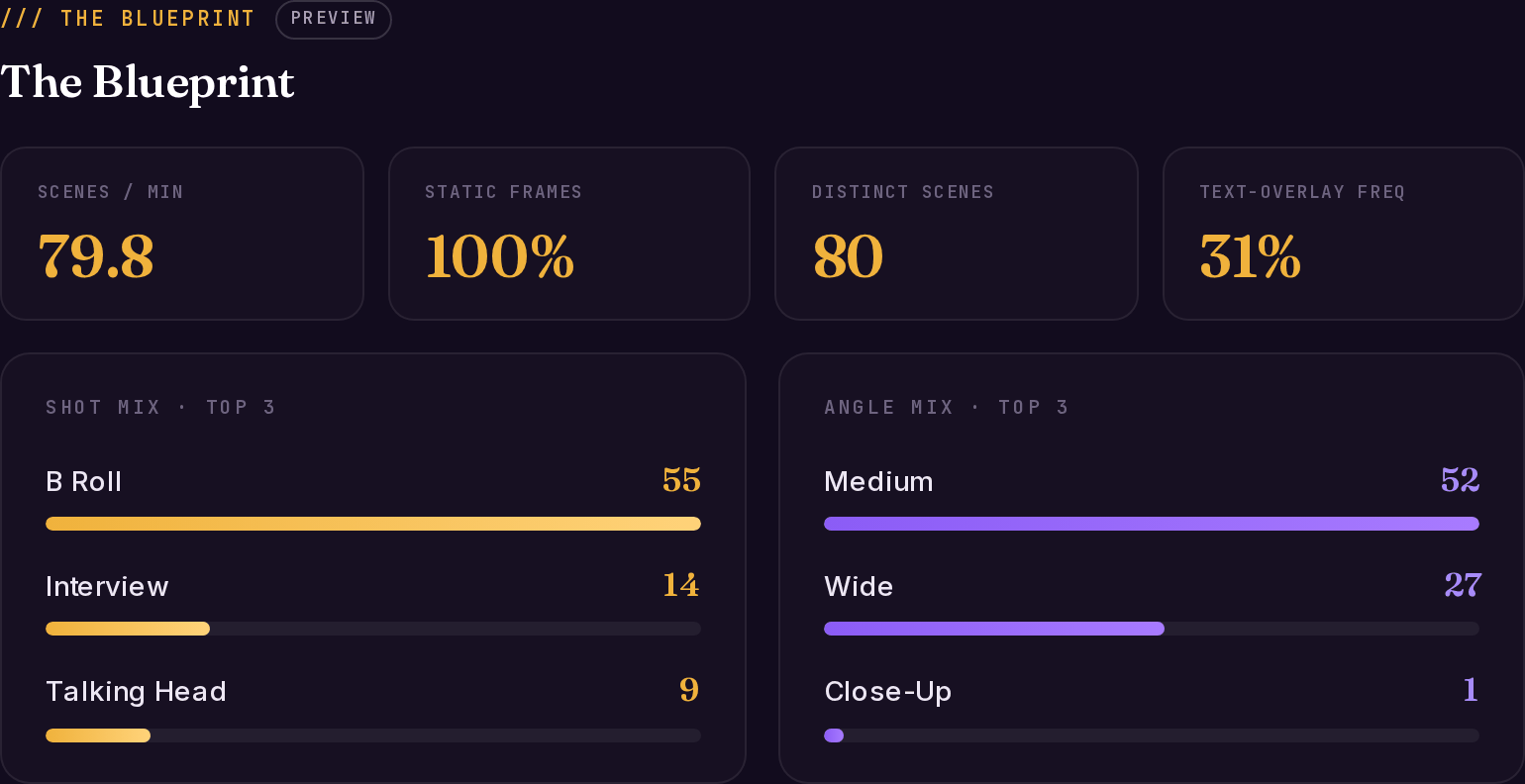
The aggregate blueprint is what the The Blueprint tab renders (and whatblueprint.json exports from the app):
| Field | What it tells you |
|---|---|
video_duration_seconds / total_frames_analyzed | Runtime and how many frames were read |
distinct_scenes | Real scene count, deduped by subject change |
scenes_per_minute | The pacing number. High = attention-managed; low = deliberate |
scene_type_distribution | Count + % for every shot type — the shot mix |
camera_angle_distribution | Count + % per angle — the camera language |
visual_style_distribution | How consistent the visual treatment is |
animation_distribution / animated_frames_pct / static_frames_pct | How much of the video is motion graphics vs. static footage |
text_overlay_frequency | % of frames carrying on-screen text |
color_mood_board | Top 6 colors across the whole video, as hex |
audience_prediction | Who the visuals are aimed at, read from the frames |
hook_score | 0–10, a visual read of the first 3 frames — text presence, tight framing, motion. The script layer has its own content-based hook score; see Hooks & re-hooks |
estimated_reproduction_cost / cost_breakdown | A rough static/animated/map scene split with per-scene cost estimates — a scoping aid, not a quote |
production_recommendation | Dominant style, dominant angle, and a suggested static/animated scene split for a rebuild |
scene_timeline | The ordered list of distinct scenes with their frame data — the raw material behind The Cuts |
What to do with it
- Treat the shot mix as evidence, not taste. If the top performer in your niche runs 60% tight talking-head and 30% product screen, that’s the working pattern — write your scenes into those slots.
- Read
scenes_per_minuteagainst your own edit. A 3× pacing gap between your draft and the reference usually explains a retention gap better than the script does. - Use
text_overlay_frequencyto decide your caption strategy. 30%+ overlay frequency in a performing video means the text layer is structural, not decorative. - Hand
color_mood_boardto whoever grades or generates your visuals — it keeps a rebuild in the same visual family without copying any footage.
Related layers
The Cuts
The blueprint’s scenes as real, playable shots — clip by clip.
Script analysis
The narrative skeleton the visuals are carrying.
Scorecard
How well this build executes for its format.
Recreation
Turn the blueprint into prompts your image and video tools understand.