

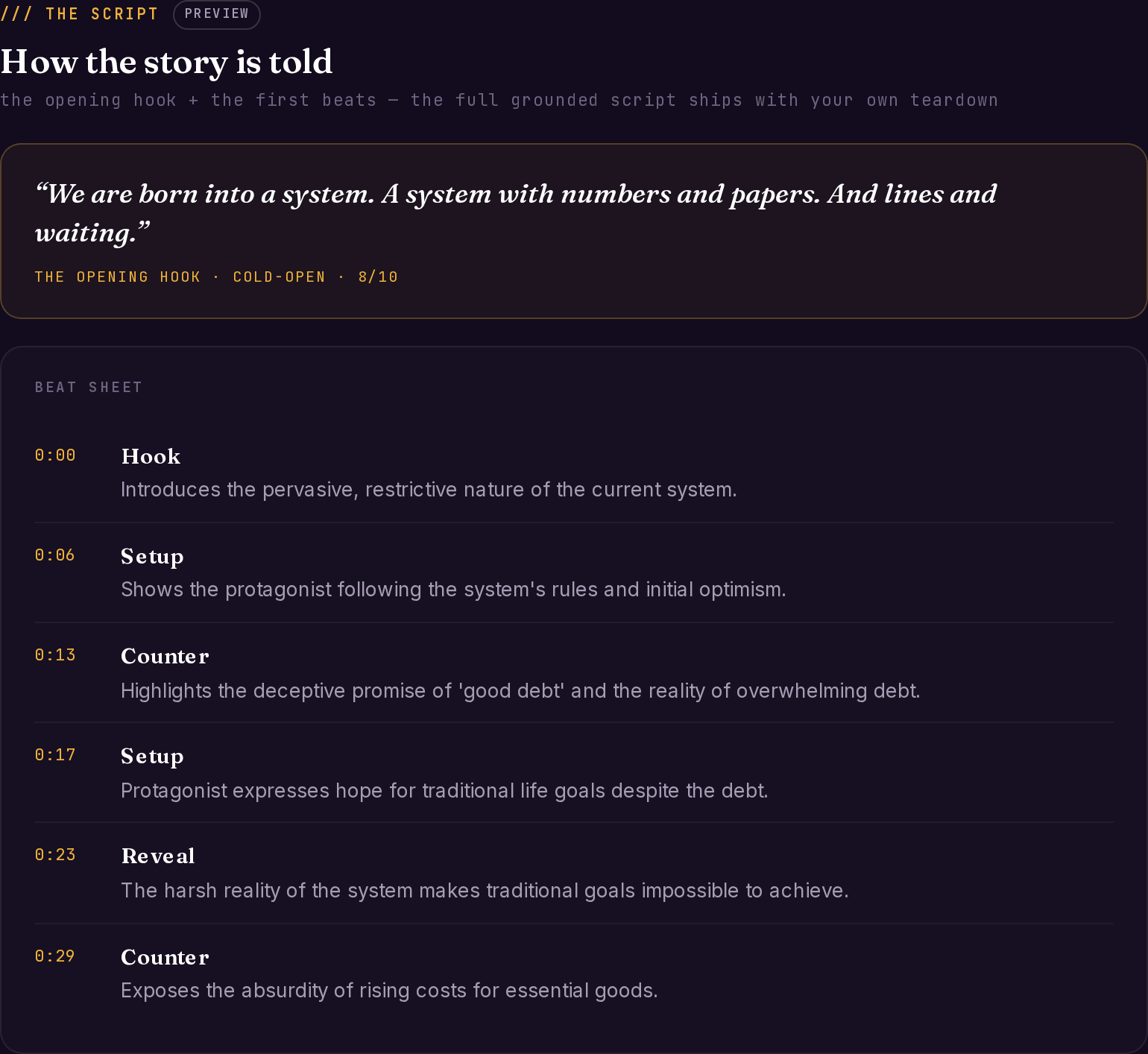
The Script tab on a live teardown - the opening hook, type, strength, and beat sheet.
The 7-element skeleton
hook
The opening move, quoted from the transcript.
Hooks get a full page of their own: Hooks & re-hooks.
rehooks
Every point where the video re-earns attention after the open:
heros_journey
The story spine in five slots: who, want, obstacle, turn, and resolution. The ending can be null when the video deliberately leaves the loop open.
beats
The timestamped beat sheet. Each beat has start_sec, a label, and a one-sentence summary.
Common labels: Hook, Setup, Authority, Proof, Re-hook, Reveal, Counter, Resolution, CTA.
ctas
Two slots, soft and hard, each with timing, text, and type. Soft CTAs include comment, save, like, and share. Hard CTAs include subscribe, link, product, and sub-channel. CTA placement tells you how aggressive the conversion logic is.
phrases
Repeated verbal tics: text, count, and function. Signature phrases are part of a channel’s format. Notice the mechanism, then write your own language.
vo
Voice-over delivery: tone, pace, pauses, and cadence note. Use this for casting, recording direction, and understanding whether the performance is fast, calm, intimate, instructional, or high-energy.
Structure match
The extracted skeleton is compared against known storytelling skeletons curated from outlier channels. You getbest_match, confidence, why_it_fits, what_doesnt_fit, an alternative_match, and example channels that use the same structure.
Draft from the skeleton
From the app, you can pour your own topic into the extracted skeleton. The inherited pieces are structure only: hook type, re-hook cadence, beat sequence, CTA placement, and voice direction. The wording and subject are yours.Diagnostic fields
Alongside the skeleton, the analysis keeps a set of diagnostic reads:hook_strength, emotional_arc, pacing, content_patterns, script_style, virality_signals, key_topics, narrative_summary, and cta_present.
Reading script analysis is the working guide to those fields.
What to do with it
- Start with the beat sheet. Count the beats, note the labels and timing, then write your script into the same slots.
- Match re-hook cadence, not lines. If the reference re-hooks every 20 seconds, your script needs a new reason to keep watching every 20 seconds.
- Check CTA placement before CTA copy. A soft CTA at the midpoint and a hard close is a different machine than a single hard close.
Related layers
Hooks & re-hooks
The attention machinery, in depth.
Reading script analysis
The diagnostic fields, value by value.
Scorecard
How the execution rates for its format.
What it's selling
The format and meaning layer this skeleton serves.