

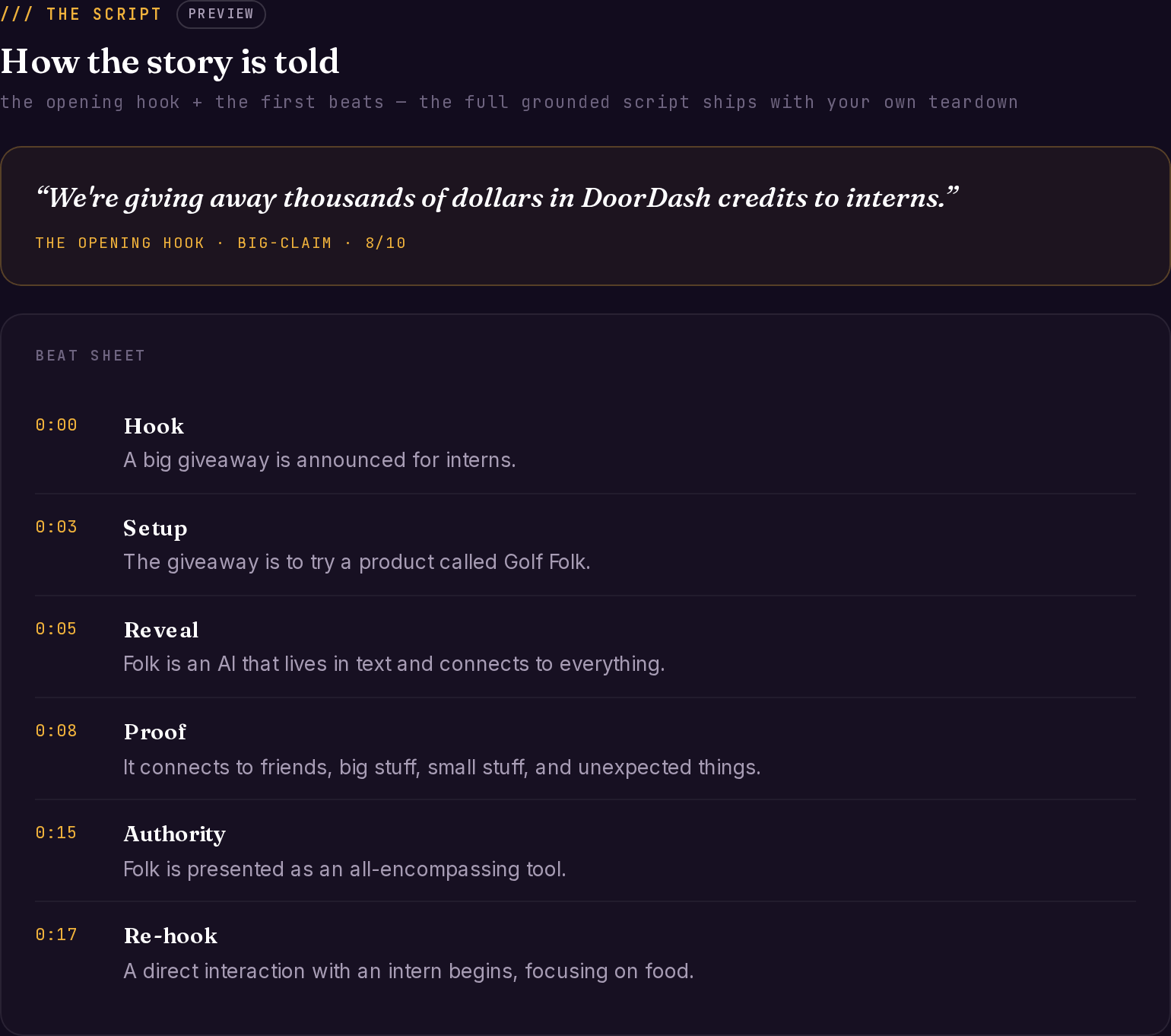
A hook on a live teardown — quoted verbatim, typed as big-claim, scored 8/10 — with the beat sheet showing a re-hook at 0:17.
The hook
Hook types
Re-hooks
Attention decays; performing videos re-earn it on a cadence. Each re-hook entry:
Re-hooks also show up as labeled beats in the beat sheet, so you can see them in the context of the whole structure.
Three hook readings, one video
videngineer reads the hook three ways — they answer different questions:
A video can score high visually and low on content — a beautiful open that says nothing — and that split is itself a diagnosis.
What to do with it
- Write your hook in the same type, never the same words. If the reference wins with a
big-claim, your video needs a big claim about your subject — matching the shape is the transferable part. - Map the re-hook cadence onto your script length. A re-hook every ~20 seconds in the reference means your 60-second version needs two. Put them in the beat sheet slots before writing lines.
- Diagnose weak hooks with the split reads. High views with a sub-55 hook strength usually means distribution is doing the work — study that channel’s distribution, not its opening line.
- Test hooks against your cold audience. The hook exists for people who don’t care yet; if your open only works for people who already know you, it isn’t a hook.
Related layers
Script analysis
The full skeleton the hook belongs to.
Scorecard
Where the hook sits in the format score — and how much it’s weighted.
The Cuts
The opening shot itself, as a playable clip.
The Blueprint
The visual hook read — what the first frames show before a word lands.