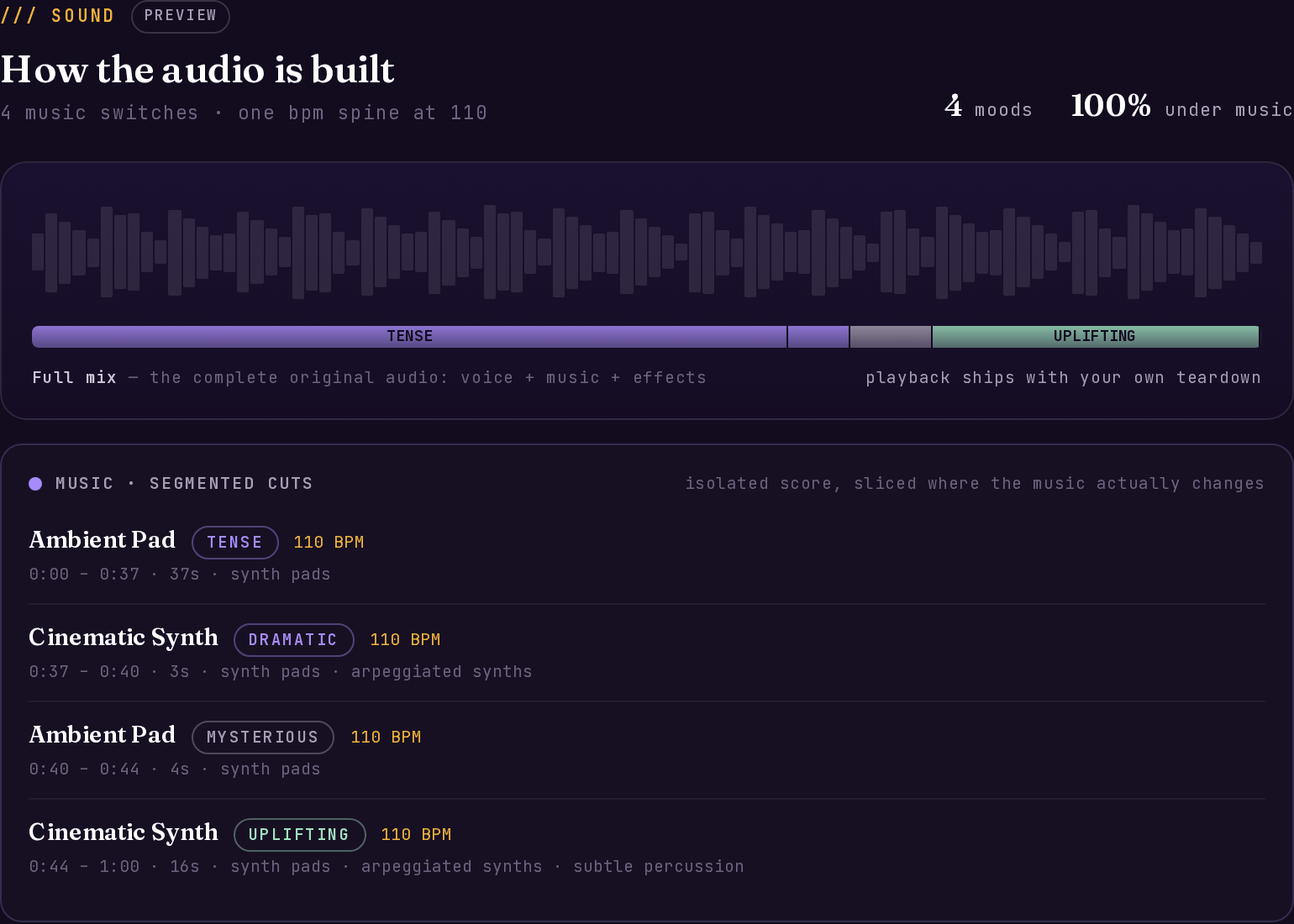
The Sound layer answers: how is the audio built? Rather than a flat list of timestamps, the analysis maps sound design onto the video’s scene timeline — for each scene: what music is playing, which sound effects fire, and what the voice is doing. It mirrors how an editor lays out a timeline: video, voice, SFX, music.
Sound layer showing a waveform with mood bands (tense to uplifting) and music segments with genre, mood, and BPM
Live example: Coinbase — ‘Break The Cycle’ teardown, Sound tab — 4 music moods, one BPM spine at 110.

Field reference

per_scene

One entry per scene row, in assembly order:
FieldWhat it holds
scene_index / start / endWhich scene and its time window
music.present / music.moodWhether music plays and its mood — tense, uplifting, dramatic, playful, dark, neutral, sad, epic, mysterious, energetic, or none
music.genreSpecific — “cinematic-orchestral”, “lo-fi hip-hop”, “ambient-pad”, “synthwave”…
music.bpm_estimate / music.instrumentsTempo and the 2–4 instruments or synths heard
music.rolebed | lead | stinger | transition | silence
sfx[]Each effect: at, a specific type (“riser-buildup”, “sub-drop”, “tape-stop”, “UI-click”, “cash-register-ding”…), description, intensity (subtle | medium | punchy), purpose (transition | emphasis | emotional_beat | comedic | attention_grab | ambient)
voice.present / voice.toneWhether there’s voice and its delivery — “energetic-narration”, “calm-explainer”, “breathy-whisper”…
summaryThe scene’s overall audio vibe in one sentence

music_segments

Consecutive scenes with the same musical mood are merged into continuous bands — this is the “Music · segmented cuts” list on the teardown page. Each segment: start, end, mood, genre, bpm_estimate, instruments, role (bed | lead | transition | drop | intro | outro).

sound_palette

The whole video’s audio fingerprint:
FieldWhat it tells you
total_sfx_events / unique_sfx_types / type_countsHow busy and how varied the SFX layer is
dominant_purposeWhat the SFX are mostly for — transitions, emphasis, emotional beats…
music_dominance_pctHow much of the runtime sits under music
silence_used_as_toolWhether silence is deployed deliberately — a strong signal in ads
sound_densitysparse | moderate | dense
voice_styleThe dominant voice tone across the video

recreation_recipe and signature_moves

recreation_recipe is a 3–4 sentence spec you can hand to a sound designer — overall genre and BPM range, the dominant SFX palette, key transition cues, voice-over style. signature_moves lists the 2–4 audio techniques that make this video’s sound distinctive.

Stems

On demand, the original audio can be split into separated stems — vocals / drums / bass / other — plus two merged logical layers: music (drums + bass) and SFX (other). The vocals stem also powers the voice-isolation workflow for cloning setups. Stems are stored with the teardown and downloadable from the app.

What to do with it

  • Brief your music search with music_segments, not adjectives. “Ambient pad, tense, 110 BPM, 0:00–0:37, then uplifting synths to the close” finds the right track in one pass.
  • Copy the SFX placement, choose your own sounds. If every scene transition carries a riser and the product reveal lands on silence, that architecture transfers — the specific samples shouldn’t.
  • Check silence_used_as_tool before adding more sound. High-performing ads often earn their loudest moment by going quiet first.

The Cuts

The shots these audio scenes are synced to.

Script analysis

The voice-over element — tone, pace, pauses.

Recreation

The visual half of the rebuild recipe.

Scorecard

Where sound design shows up in the format score.